Ethiopia

Ethiopia

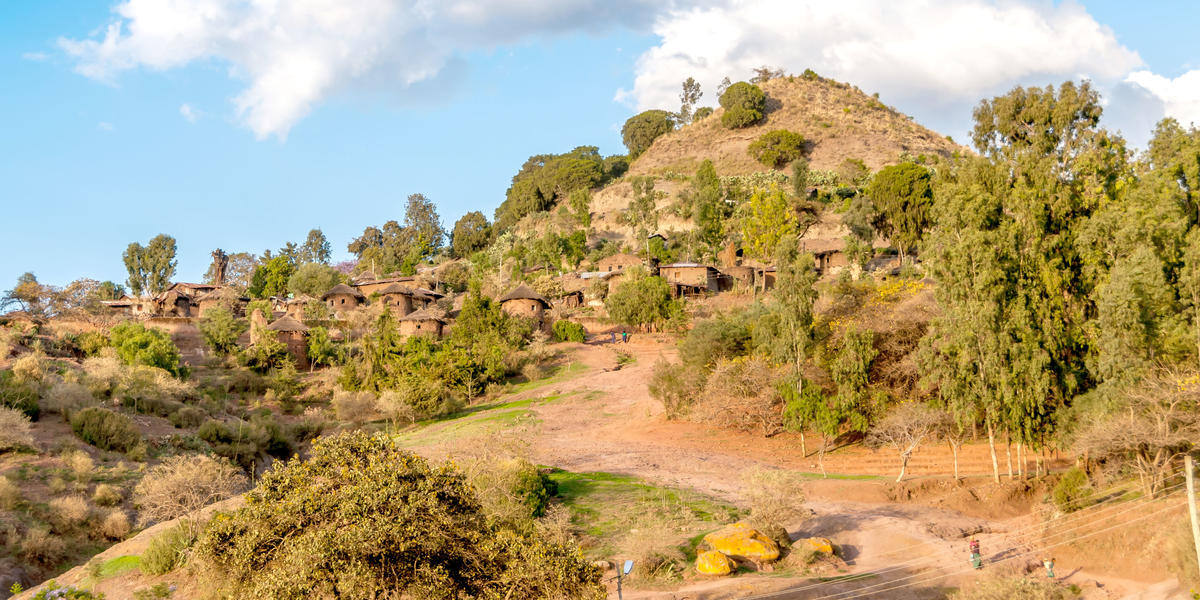
Situated in the Horn of Africa, Ethiopia boasts extraordinary natural features, a vast range of wildlife, and a captivating historical and cultural heritage. An increasing number of visitors frequent this treasure trove filled with unique attractions. Popular attractions include the medieval castles of Gondar, the walled city of Harar, and Lalibela, a pilgrimage site known for its ancient monolithic churches hewn into the area’s steep rocky hillsides. Ethiopia’s stunning natural landscapes are the real tourist drawcard. From the lush Simien Mountains to the sulphur vents of the Danakil Depression, the country’s outstanding natural environment is unforgettable. Bahir Dar, located on Lake Tana, is popular as a base to explore the fascinating monasteries on the numerous islands dotted around the lake and the Blue Nile Falls, which are arguably the most spectacular falls in North Africa.

Read More: Ethiopia

Regions


  • Placeholder image
  • Placeholder image
  • Placeholder image
  • Placeholder image
  • Placeholder image
  • Placeholder image
  • Placeholder image
  • Placeholder image

Travel Information


General

Language: Amharic is the official language of Ethiopia, although English, Italian, French and Arabic are also spoken. Outside the larger cities and towns,…

Electricity

Plug Type: C, E, F, G and L Voltage (V): 220 V Frequency Hertz (Hz): 50 V*A Travel plug adapter and voltage converter might be necessary depending…

Banking

Currency: Local currency: Ethiopian Birr Symbol: Br ISO code: ETB Subunit: santim Banknotes: 1, 5, 10, 50, 100, 200 birr Coins:…

Cuisine

Food and water safety: Can you drink the tap water: No Fresh fruit and veg: Yes, if peeled and cooked Ice: No Meat: Yes, if well-cooked Street…

Climate

Annual rainfall: 850.14 mm Average temperature: 24°C  Summer: Average Highs: 25°C Average Lows: 15°C Winter: Average…

Transport

Air: Main airlines: Ethiopian Airlines International Airports: Addis Ababa Bole International Airport    Road: Tar roads:…

Dress

Spring and Summer Cool, light, breathable and comfortable: Yes Lightweight warm clothes: Yes  Winter and Autumn Jerseys, cardigans,…

Health

Please consult your health-care provider 4-6 weeks prior to travel to ensure you are receiving all required vaccinations and that the medication has…

Safety

Visa

U.S. citizens are required to obtain a visa for entry into Ethiopia. Non U.S. citizens should consult with your local embassy. Obtain your Ethiopia…


Related Tours


  • Dear David Do you remember us? We spent our holyday in Namibia in 2007 following your itinerary. This email is to inform you, that advertising of your agency is now shown in the italian travel web magazine Viaggionelmondo.net In this…

    Carla and Riccardo

  • We just came back from a safari in Botswana, Namibia and Zambia, which was organised by Charlotte at ATI Holidays. We had a truly fantastic time, and would like to thank them for their help in organising it all. The…

    Matthew Haler

General

Language:
Amharic is the official language of Ethiopia, although English, Italian, French and Arabic are also spoken. Outside the larger cities and towns, indigenous languages are likely to be spoken - of which there are over eighty, along with some 200 dialects. The most common of these are Amharic, Oromo, Tigrinya and Somali.

In the northern and central parts Ethiopia different Semitic languages are spoken. Namely Tigre, Tiginrya, Guraginya and the official national language Amharic. The root of these languages, Ge'ez, only survives today in church liturgy and literature.

The Sidama languages are spoken to the south-east and to the east and parts of the south are the Cushitic-speaking peoples of the Oromos, the Afars and the Somalis.

To the west and south-west are the Nilotic peoples with their own distinctive language and culture.

In other areas of the country there are smaller communities whose cultures, languages and traditions derive from different facets of Ethiopia's long history.

National Emergency Numbers:
All emergencies dial 911

Public Holidays:
The dates of certain public holidays change from year to year – refer below. If a public holiday falls on a Sunday, then the Monday is also declared a public holiday.

Jan. 07 - Ethiopian Christmas
Varies - Milad un Nabi (Birth of Prophet Muhammad)
Mar. 02 - Victory of Adowa
Varies - Ethiopian Good Friday
Varies - Ethiopian Easter
May 01 - Labor Day
May 05 - Patriots Victory Day
May 28 - Downfall of the Dergue
Varies - Eid al-Fitr (End of Ramadan)
Sep. 11 - Ethiopian New Year (Entutatash)
Sep. 27 - Finding of the True Cross (Meskel)
Varies - Eid-al Adha (Feast of Sacrifice)

Social conventions:.
It should be remembered that sometimes it can cause offence to take photographs without first asking permission, particularly in Afar and the Omo valley where the people may ask for money.

Photography in churches is generally allowed but in the more famous tourist attractions like the Blue Nile Falls you can expect to be charged.

In some areas such as airports and around military camps photography may be prohibited altogether. Taking photographs or filming army, police or official personnel or government buildings can result in a penalty and having your film and/or camera confiscated.

Time Zone:
Ethiopia is also three hours ahead of Greenwich Mean Time (GMT).

However, there is no adjustment of clocks for winter or summer time, so there is no putting clocks backward or forwards an hour. Being close to the Equator there is almost twelve hours of constant daylight. In Addis Ababa, sunrise begins at around 06.30 and sunset is about 18:45.

Tipping
Most hotels and restaurants include a service charge, however visitors might want to leave a small tip of one or two birr to show their appreciation of good service. It is customary to tip drivers and guides.

Bell Boys at hotels (per piece of luggage) ………………………..…… USD 1.00

Luggage assistance at the airport (per piece of luggage) ………. USD 1.00

National escort guide ……….………. USD 10.00 – USD 15.00 per person/ per day

Regional guide ………………………..… USD 5.00 – USD 10.00 per person/ per day

Driver ………………………….………….... USD 5.00 – USD 10.00 per person/ per day

Head Cook (for mobile camp or trekking) ……… USD 10.00 – USD 15.00 per person/ per day

Hotel/Camp staff (to be split among all staff) ……. USD 5.00 – 10.00 per person/per day

Scout ………………………………………………... USD 5.00 per person/per day

Restaurants (per bill) ……………………………... 5 - 10% of the total

Value Added Tax (VAT)
The VAT rate in Ethiopia is 15%.

US Embassy
Address: Entoto Street P.O. Box 1014 Addis Ababa
Tel: Switchboard:130-6000 and After Hours: 130-6
Website: ethiopia.usembassy.gov

Electricity

Plug Type: C, E, F, G and L 
Voltage (V): 220 V 
Frequency Hertz (Hz): 50 V

*A Travel plug adapter and voltage converter might be necessary depending on your appliances. 

Banking

Currency: 
Local currency: Ethiopian Birr 
Symbol: Br 
ISO code: ETB 
Subunit: santim 
Banknotes: 1, 5, 10, 50, 100, 200 birr 
Coins: 1, 5, 10, 25, 50 santim; 1 birr 

Banking: 
Card Transactions: 
ATMs: Yes 
Mastercard: Yes 
Visa: Yes 
American Express: Yes/No 
Diner’s club: Yes/No 
 
Banking Hours:
 
Weekdays: 08:00-17:30 
Weekends: 08:00-16:00 
Public Holidays:  
Foreign exchange services: Yes 
 

Cuisine

Food and water safety: 
Can you drink the tap water: No 
Fresh fruit and veg: Yes, if peeled and cooked 
Ice: No 
Meat: Yes, if well-cooked 
Street food: No 
 
Local cuisine: Ethiopian cuisine is renowned for its injera, a sourdough flatbread paired with spicy stews like doro wat, a chicken dish, and misir wat, a lentil stew. Meals are often shared from a communal plate, emphasizing a social dining experience. Spices such as berbere add distinctive flavours. 

Drinks:  

Ethiopean coffee 

Areke – Clear alcoholic beverage 

Tej - Honey wine 
 
Tipping: 10% 

Climate

Annual rainfall: 850.14 mm 
Average temperature: 24°C 
 
Summer: 

Average Highs: 25°C 

Average Lows: 15°C 

Winter: 

Average Highs: 23°C 

Average Lows: 11°C 

Best time to visit: The best time to travel to Ethiopia is the dry season between October and June, when the highlands are green and lush, ideal for hiking. 

Transport

Air: 
Main airlines: Ethiopian Airlines 
International Airports: Addis Ababa Bole International Airport   
 
Road: 
Tar roads: Yes 
Gravel roads: Yes 
Valid International Driver's License needed: Yes 
Car hire available: Yes 
Taxis: Yes 
Uber available: No 
 
Bus: 
Inter-city bus services: Yes 
Local city bus networks: No 
 
Rail:
 
Railway system: Yes 
Subway System: No 
 
Water: 
Ferries: Yes/No 
Water taxis: Yes/No 
Leisure cruises: Yes/No 

Dress

Spring and Summer 
Cool, light, breathable and comfortable: Yes 
Lightweight warm clothes: Yes 
 
Winter and Autumn 
Jerseys, cardigans, sweaters, jackets: Yes 
Heavyweight clothing and boots: Yes 
 
General 
Umbrella and raincoat: Yes 
Warm gloves, hat and scarf: Yes 
Swimming costume (bathing suit): Yes 
Hat, sunglasses and sunblock: Yes 
Walking shoes: Yes 
Casual: Yes 
Smart-casual attire: Yes 

Health

Please consult your health-care provider 4-6 weeks prior to travel to ensure you are receiving all required vaccinations and that the medication has enough time to take effect. We highly recommend the purchase of travel insurance with medical benefits and that you bring any personal medication with you. Please also check with your health department prior to departure for any changes in health regulations.

Required Immunizations/Vaccinations:

Yellow Fever - all travelers coming from a yellow fever infected country will be required to show a valid Yellow Fever certificate on arrival. It is otherwise not required or recommended. You should be vaccinated at least 10 days before you travel, as this will allow enough time for your body to develop protection against the yellow fever infection. Your proof of vaccination certificate will only become valid after this time.

Recommended Immunizations/Vaccinations:

Malaria prophylaxis - highly recommended for all travelers 
Meningitis - highly recommended during the dry season (December–June)
Cholera - recommended for adults who are traveling to an area of active cholera transmission. Most people do not travel to areas of active cholera transmission. Avoiding unsafe food and water can also prevent many cholera infections. Cholera is rare in travelers but can be severe

Malaria

Malaria can be a problem in Ethiopia at the lower altitudes, say through the Rift Valley. Expert opinion differs regarding the best approach to malaria prophylaxis. It is important to bear in mind that malaria may be contracted despite chemoprophylaxis, especially in areas where chloroquine resistance has been reported. 

We strongly recommend you take the following preventative measures:

Use plenty of mosquito repellent. Some properties provide a locally made repellent but please bring your own as there may be skin sensitivity.
Wear long-sleeved shirts and trousers/slacks in the evenings.
Please use the mosquito net over your bed where supplied/available.
If staying in a bungalow or tent, spray with a suitable insecticide to kill any mosquitoes that may have flown into your room.
Mosquito coils are also effective.

There is a six to seven day minimum incubation period before symptoms present themselves. If you become ill on your return, while still on prophylaxis or even once you have stopped taking them, ensure that your doctor does everything to establish that your illness is not malaria. Please remember the best precaution is the preventative kind. 

It is inadvisable for pregnant women to visit malarial areas as malaria infection during pregnancy can be detrimental to both mother and child.

Visa

U.S. citizens are required to obtain a visa for entry into Ethiopia. Non U.S. citizens should consult with your local embassy.

Obtain your Ethiopia tourist visa by applying for an eVisa prior to traveling at https://www.evisa.gov.et/#/tourist-visa. Tourist visas are also available upon arrival at Bole International Airport.